
The Well-being of Future Generations Act (2015) is Wales’ best-known piece of legislation, celebrated internationally. It is a framework that draws everyone together into the process of designing a stronger society that can take us through the challenges of the future. What better basis could there be for reforming the food system?
By requiring government bodies to give communities a voice and to involve them in their planning, as part of its New Ways of Working, the Act is a gift to food activists – but only if we know how to use it. And there is the sticking point, because not many of us understand how it is supposed to work.
We had discussed this at a WRFFC conference session in 2021 and thought it would be a good topic for an online meeting, which was held in October of last year. You can view the recording below, and it was full of insights from both the panel and the audience.
The Future Generations Office was represented by Jenny McConnel, Sustainable Development Advisor. We had three volunteer food activists: Mike Eccles of Hay Public Library, who ran a people’s assembly on local food distribution in 2023, and Camilla Saunders and Karen Plant of Sustainable Food Knighton, who have been campaigning against intensive poultry units in the Wye Valley, and for better food. Finally, Augusta Lewis, who works for Social Farms and Gardens at Carmarthenshire Local Food Partnership, came to share her experience of how the public sector, businesses and voluntary groups actually get along together.
A common complaint about the Act is that is toothless. You can’t take the government to court for, say, failing to be a ‘Globally Responsible Wales’ because they haven’t stopped imports of soya linked to rainforest destruction. It works in more subtle ways, involving consultation and consensus building. But it can still be useful to community groups, who can hold local authorities to account if they do not follow their own Well-being Plans. In addition the Future Generations Office, which does have considerable convening power, is working behind the scenes to influence food policy.
The Future Generations Office strategy for 2023-2030, Cymru Can, sets out five key missions, of which improving its own implementation is one. It has a whole section on food, which it is using as a focus to bring all the other missions together, stating: “We will involve the public, private and voluntary sectors in our plans to: Advocate for Welsh Government to develop a long-term food strategy.”
Meanwhile, food is becoming more prominent in the Well-being Plans that every Public Services Board is required to produce and Carmarthenshire Council has even been working on a Future Generations menu for schools. The Future Generations Office is probing the technicalities of food procurement too. With the rise of the Local Food Partnerships, and projects such as Welsh Veg into Schools, things are starting to change.
But there is a long way to go. Part of the challenge is to get people together in a way that leads to positive action. Augusta described how she uses the seven well-being goals of the Act to create common ground for discussion between different sectors. As she says, nobody can disagree with the call for health, prosperity or strong communities, and everyone eats, so there is always some agreement here. Businesses want to contribute to their communities, not simply make profits. This identification of shared values was the thinking behind the Wales Food Manifesto as well.
There will always be differences of course, and that is where People’s Assemblies have a role to play. Mike described how active listening, which means paying attention to what people say in order to understand them, not to come back with a counterargument, can change the public debate. This is sometimes known as deliberative democracy, and it has been well tested across Wales in recent years. As he says, it is important to focus on hope and to give people a sense of agency, moving out of the ‘delirium’ of consumerism and into citizenship (for more on this see the Food Citizenship website).
All of this should give some encouragement to food activists. The Act provides a route, even if not always an obvious one, for communities to get their voice into government. And we need them to, because while governments work in separate policy areas like farming, food and health, local communities have the task of bringing everything together again. If we can feed the results of policy changes back to government, the whole system gains.
As Jenny says, it is a challenging situation. The Future Generations office is working to encourage people to engage with the processes of the Act. It is also scrutinising government policy and working on critical blockages in the food system. Do food export targets (high value products, often processed foods) contradict health targets (more fruit and vegetables) and actual practice (red meat)? Are food hygiene regulations unfairly excluding small businesses from supplying school meals?
Meanwhile, civil society can meet and support the Act. The Wales Real Food and Farming Conference is part of this, and so is the Wellbeing Economy Cymru (WeAll) who were represented on the call, and many other organisations. But most of us are not politicians or civil servants, and that way of working does not come naturally. It can lead to burnout and disillusionment.
Which leads to an interesting point. The strength of communities lies in personal connections and culture, and in all the details of history and geography that produce such variation in even a small place like Wales. We must find ways for that integrity and energy to renew our society and government from the ground up, by making it easier for the public sector and the grassroots to support and respect each other, developing courageous leadership on both sides. That means building on shared humanity, and food is a good place to start.
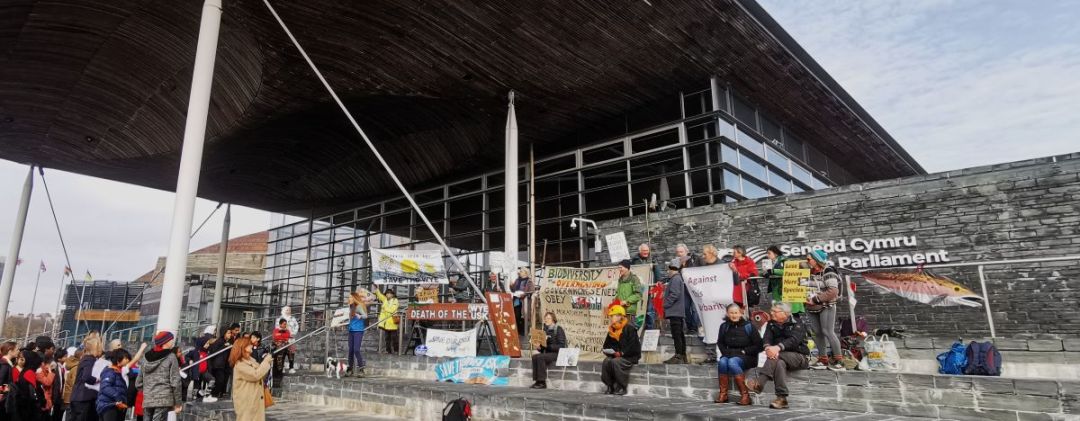
Image: Sustainable Food Knighton’s 2023 event at the Senedd, Jane Powell.

 CyFAN Cymru